
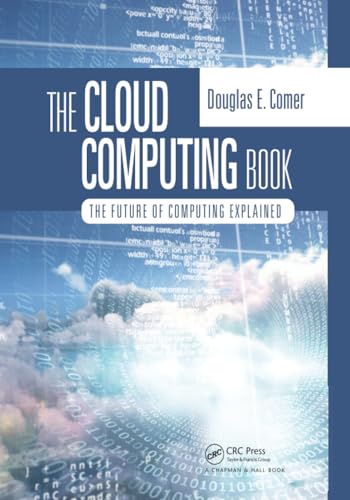
The cloud computing book : the future of computing explained / Douglas E. Comer, Department of Computer Sciences, Purdue University, West Lafayette, IN 47907.
Material type: TextPublisher: Boca Raton : CRC Press, 2021Edition: First editionDescription: 1 online resource (xvi, 269 pages)Content type:
 - text
- computer
- online resource
- 9780367706845
- 9780367706845
- 004.67 COM 2021 23
- QA76.585
| Item type | Current library | Call number | Copy number | Status | Date due | Barcode | |
|---|---|---|---|---|---|---|---|
 Book
Book
|
Symbiosis International University, Dubai | 004.67 COM 2021 (Browse shelf(Opens below)) | 1 | Checked out | 10/03/2026 | SIU00828 | |
|
Book
|
Symbiosis International University, Dubai | 004.67 COM 2021 (Browse shelf(Opens below)) | 2 | Available | SIU00829 | ||
|
Book
|
Symbiosis International University, Dubai | 004.67 COM 2021 (Browse shelf(Opens below)) | 3 | Available | SIU00830 | ||
|
Book
|
Symbiosis International University, Dubai | 004.67 COM 2021 (Browse shelf(Opens below)) | 4 | Available | SIU00831 | ||
|
Book
|
Symbiosis International University, Dubai | 004.67 COM 2021 (Browse shelf(Opens below)) | 5 | Available | SIU00832 |
Includes bibliographical references and index.
"The latest textbook from best-selling author, Douglas Comer, this class-tested book provides a comprehensive introduction to cloud computing. Focusing on concepts and principles, rather than commercial offerings by cloud providers and vendors, the text gives readers a complete picture of the advantages and growth of cloud computing, cloud infrastructure, virtualization, automation and orchestration, and cloud-native software design. The book explains real and virtual data center facilities, including computation (e.g., servers, hypervisors, Virtual Machines, and containers), networks (e.g., leaf-spine architecture, VLANs, and VxLAN), and storage mechanisms (e.g. SAN, NAS, and object storage). Chapters on automation and orchestration cover the conceptual organization of systems that automate software deployment and scaling. Chapters on cloud-native software cover parallelism, microservices, MapReduce, controller-based designs, and serverless computing. Although it focuses on concepts and principles, the book uses popular technologies in examples, including Docker containers and Kubernetes. Final chapters explain security in a cloud environment and the use of models to help control the complexity involved in designing software for the cloud. The text is suitable for a one-semester course for software engineers who want to understand cloud, and for IT managers moving an organization's computing to the cloud"-- Provided by publisher.
Description based on print version record and CIP data provided by publisher; resource not viewed.
There are no comments on this title.